On this date, 8 July in 2014, the 10th day of Ramadhan, we had obtained our very first twenty colonies of
Heterotrigona itama stingless bees (meliponines). On 26 June 2016, the 21st day of Ramadhan, we lost the same number to the most feared pest of stingless bees.
From the first twenty colonies, we had gradually increased the number to one hundred and thirty over the next two years. It wasn't easy as we had to plant a lot of flowers and trees as the farm is located amongst palm oil plantations which do not provide a source of nectar, resin, pollen and other elements needed to sustain the bees.
Cultured stingless bees in the country, mainly in the northern and east coast states of peninsula Malaysia were invaded by two different kinds of pests simultaneously: the black soldier fly (
Hermetia illucens) and the sap beetle (
Haptoncus luteolus). Some farms had lost hundreds of logs. Bilut Valley Bee Farm was not spared by this ravaging infestation that we believe, was an after effect of the
El Nino phenomenon. Not as many as others but a great loss to us, nevertheless.
The situation was reported by
Sinar Harian following an interview with Assoc. Prof. Dr. Shamsul Bahri Abd Razak from Universiti Malaysia Terengganu. Read the report
here.
 |
All I could do was watch, mostly Aiman's
hard work on the toppings, go to ash |
|
We were devastated but we had to make a fast decision to cut losses to the minimum and contain the infestation as quickly as possible. The meliponines had already absconded and had left their larvae infested hives. We had been advised by experts to burn these logs
pronto.
 |
I was so proud of Marzia;
despite the pressing situation, she had the foresight
to collect a sample of the honey from the
infected logs that could be used for analysis. |
Although the logs were empty, my heart ached and tears fell uncontrollably seeing the logs being carried away. They once housed our beloved bees which were thriving well, producing a good amount of honey and given me so much joy. It was most unbearable wondering if they had found suitable trees in which they would build their new hives. Thankfully, Aiman, Marzia and my future son-in-law Faisal who happened to be visiting, were there to provide support. They had done the job of disposing the logs very quickly and efficiently.
 |
I had insisted Aiman saw the logs before
burning to ensure no bees, especially
a queen bee was left behind. |
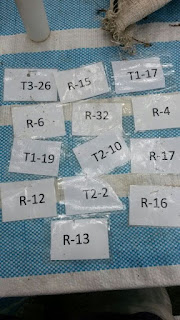 |
| The casualties. |
 |
Firdaus - Dr. Shamsul's trusted and
able research assistant. |
 |
Assoc. Prof. Dr. Shamsul
is possibly the only academician in
the whole country who took the initiative
to gather samples from infested hives to
identify the pests, find out the cause and
also seek ways to eradicate the infestation. |
During this time, I was also in touch with my husband, my partners and a
WhatsApp chat group comprising researchers from University Malaysia Terengganu, officers from the Perak Agriculture Department and fellow beekeepers. They all had driven me to do whatever that was necessary and had provided much needed consolation in facing a sudden loss of thousands of my precious bees.
Thanks to each and everyone of them, I rebounded rather quickly from the calamity. There was a point when I had started to think if I had made the right decision going into meliponiculture. But I spotted a request to visit the farm by a friend of Aiman on our Facebook wall. This stopped me from thinking that way, and I knew it was a Sign from the Divine. Nik Saufi had visited the farm twice before, and this would be his third visit...because he simply loved it there. And so did many others. So many love the honey, too. I couldn't disappoint them all.
 |
Najib - an extreme enthusiast of meliponines
appointed by UMT to be a part of their research
team. |
"
Verily, along every hardship is a relief."
"Verily, along every hardship is relief."
I had just only been enlightened about these
ayah belonging to
Surah Insyiroh a few days before the incident. It had always been simply translated to me that relief came with hardship. But it had not been highlighted that
lots of blessings come down within and during the hardship. I now bear witness to that; I was put in a vulnerable position but I am blessed with so many things and people, family who give love and support, and friends who gave a splendid show of camaraderie and
esprit-de-corps.
The
Rahmah (compassion) and blessings from Allah surpasses, reigns over
everything.
This was my Ramadhan, one that was overflowing with blessings as had been promised by Allah
swt, and one that I would not forget for I guess, a very long, long time.
Written by Aniza Zain Ahmed for my family members namely my beloved husband Ahmad Cendana who remained so cool while giving very rational advice which immediately gave me immense strength while I was shaken and frantic. My children Aiman Mazlan and Marzia Mazlan who were calm, collected and so professional and took over handling the situation when their mom was distraught, my sisters Datin Aimi Zain Ahmed and Fauziah Shariff who stood solidly by us.
Also for the Kelulut Warriors Assoc. Prof. Dr. Shamsul Bahri Abdul
Razak, Mohammad Firdaus bin Sulaiman, "Supermokh" Mokhtar Ishak, Hj. Mohd
Najib Rais Hj Mohd Noordin (UMT Kelulut researchers), Puan Nur Hafizah
Sharudin, Puan Hazrina Rashid (Perak DOA), veteren stingless beekeeper
Tuan Rosman Mohd Isa, Mat Khairil Matkentoi and Assoc. Prof. Dr.
Nurazura Adam (UPM).
 |
Puan Nur Hafizah, left, and Puan Hazrina.
Don't be fooled by their demure looks, these are hardworking, dedicated
and courageous women serving the country and it's people.
Hafizah did not hesistate even for a second in volunteering to join a
response team which Dr. Shamsul initiated to visit affected farms in Kedah.
Within a very short time, she had managed to gather officials from
DOA Penang and Kedah which included a Deputy Director and led the team
to investigate massive infestation in the beefarms.. |
 |
Matkentoi, a man of a man of all trades. He had joined the
response team on his own accord. |
 |
Rosman Mohd Isa runs and manages the biggest
stingless bee farm in Malaysia, located in Merbok. Kedah. He was the very first to highlight problems faced by
beekeepers in Kedah. He, together with Haji Najib, had made
an ad hoc visit to the affected farm and confirmed the presence
of larvae in the hives. This was followed by the formimg
of Kelulut Quick Response Team in which the duo made a second trip to the said farms. .
i was awed by the dedication of my associates, and the speed at responding
to calls for help with regards to stingless bees.
He, and the rest of the team, are warriors in the true sense of its word. |
.


